
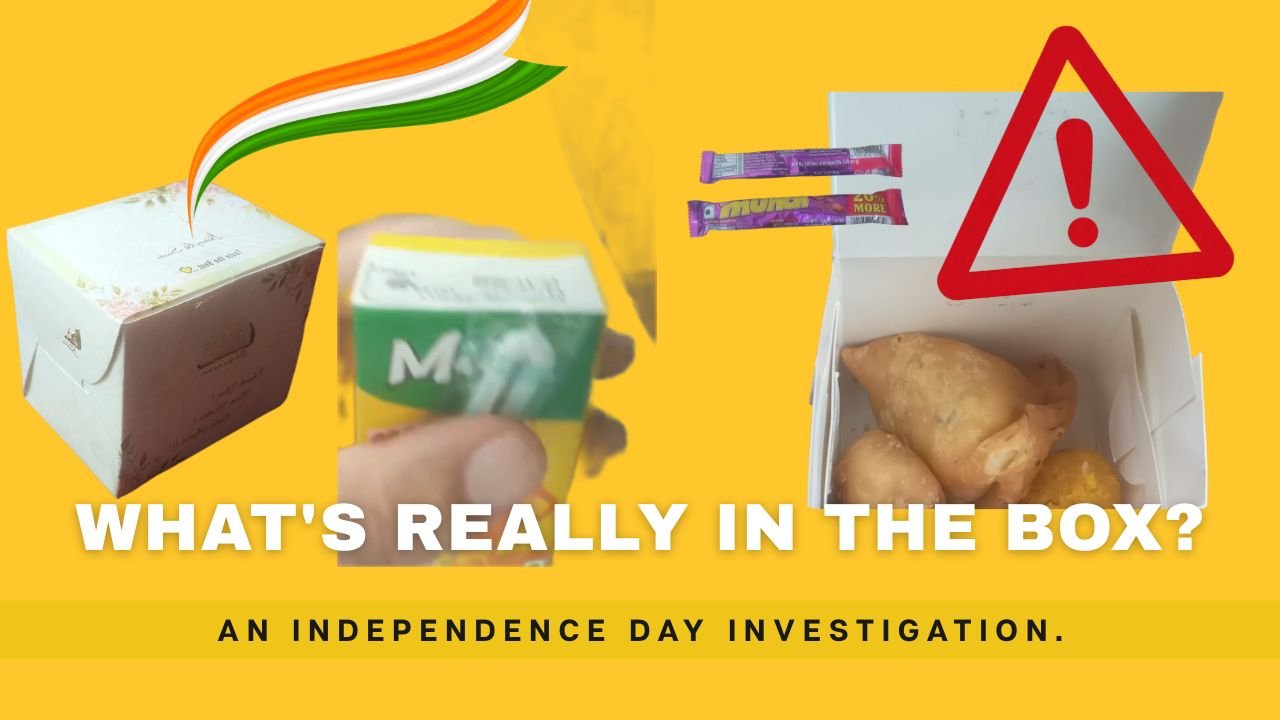
WHAT'S REALLY IN THE BOX ON THIS INDEPENDENCE?
Every Independence Day, the same script plays out in schools across the country: flag hoisting, patriotic songs, a few speeches — and then the part every child actually waits for. The refreshment box.
This year I decided to look inside that box instead of just handing it to my child and moving on.
What I found — and what I’m publishing here — isn’t a story about one bakery being careless. It’s a story about a system where nobody along the chain (bakery, vendor, school, parent, regulator) is required to ask a simple question before a child eats something in a school building: what is actually in this, and how much of it should a child be eating?
What was actually in the boxes
I visited a handful of schools in and around Sri Vijaya Puram around this year’s celebrations and looked at what was handed out as the post-celebration treat. Patterns repeated across more than one school.
School A handed out a small box from a prominent local bakery containing a deep-fried samosa, a besan laddoo, and a balushahi.
School B handed out a 10-rupee Frooti (125 ml) and a 10-rupee packaged biscuit.
School C handed out a packaged cake slice and a chocolate bar.
None of this is unusual. All of it is, on the numbers, more sugar, fat, and refined starch than a child should be eating in one sitting — and in some cases, more than the government’s own draft threshold for what counts as “high” in a school food item.
I opened one of the sealed boxes on camera. The lid was ordinary bakery packaging — floral print, “Taste the Best,” a thank-you note. What was worth noticing wasn’t the packaging. It was what was on the inside of the lid: visible oil staining, the kind that only transfers from food that’s still releasing oil after being boxed. That’s not an accusation about how many times cooking oil was reused — I have no way to verify that from a photograph, and I’m not going to pretend I do. But it’s a fair, visible fact: this was fried, it was still oily when boxed, and it went straight into a child’s hand still warm from the fryer.
What FSSAI said, four days earlier
On 11 August 2026, the Food Safety and Standards Authority of India published a draft gazette notification — not a letter, an actual proposed amendment to the Safe Food and Balanced Diets for Children in School Regulations, 2020 — setting hard numeric thresholds for what counts as “high” in fat, sugar, or sodium in food served to schoolchildren. It’s built on ICMR’s 2024 Dietary Guidelines for Indians and open for public comment for 60 days from publication.
The thresholds, exactly as proposed:
| Nutrient | Classified “high” if solid food exceeds | Classified “high” if a drink exceeds |
|---|---|---|
| Added sugar | 3g per 100g | 2g per 100ml |
| Added fat | 4.2g per 100g | 1.5g per 100ml |
| Sodium (as salt) | 0.625g per 100g | 0.175g per 100ml |
Four days later, schools across Sri Vijaya Puram handed out exactly the category of food this notification is written to flag. That’s not a coincidence I’m reading into it — it’s a calendar fact.
The box, against the limits
None of the figures below are a lab test of the specific items photographed above — I want to be upfront about that, the same way I was upfront about the oil. These are standard published figures for these food categories, from Indian food composition data and manufacturer labels. Read them as typical ranges for the category, not a certified reading of one bakery’s batch.
| Item | Typical serving | Calories | Sugar | Fat | Sodium | vs. FSSAI draft threshold | What it does |
|---|---|---|---|---|---|---|---|
| Deep-fried samosa | 1 piece (~75g) | 130–190 kcal | ~1–2g | 8–10g (mostly saturated) | 350–400mg | Fat: ~11–13g/100g → 3x the 4.2g/100g line | Saturated fat load this size is a meaningful chunk of a child’s whole day’s recommended intake, in one snack |
| Besan laddoo | 1 piece | 150–200 kcal | ~15–20g | 8–9g | Low | Sugar: ~17g/100g → ~6x the 3g/100g line | Roughly 6–8 teaspoons of sugar; high glycemic index means a sharp blood-sugar spike, not sustained energy |
| Balushahi | 1 piece | 140–160 kcal | ~12g | 7–8g | Low | Sugar: ~15g/100g → 5x the line; Fat: ~10g/100g → ~2.4x | Maida dough deep-fried and syrup-soaked; a half-fried piece absorbs more syrup and oil at the raw centre, not less |
| 10-rupee Frooti (125ml) | 1 pack | ~65–80 kcal | 13–14g added sugar | 0g | ~30mg | Sugar: ~11g/100ml → ~5.5x the 2g/100ml line | More than half a child’s entire daily sugar allowance (see below), in one drink, for ten rupees |
| 10-rupee packaged biscuit | ~1 pack (~30g) | 140–150 kcal | 6–7g | 6–7g | Varies | Sugar: ~20–25g/100g → ~7x the line | Palm oil (often partially hydrogenated in cheaper lines) as primary fat; minimal fibre or protein to offset the sugar |
| Packaged cake slice | 1 slice (~40g) | 140–160 kcal | 10–14g | 6–8g | Varies | Sugar: ~30g/100g → ~10x the line | Preservatives and emulsifiers extend shelf life at room temperature — a signal of how processed the base product is |
| Chocolate bar | 1 small bar | 130–150 kcal | 13–15g | 8g | Low | Sugar: ~28–30g/100g → ~10x the line | Adds a full extra day’s worth of sugar on top of whatever else is in the box. |
The numbers nobody hands out with the box
None of what follows is a lab test of the specific items I photographed — I want to be upfront about that, because I think honesty about what you actually know is the whole point of this kind of reporting. These are standard, published nutrition figures for these food categories, drawn from Indian nutrition composition databases and manufacturer-declared labels. Treat them as typical ranges for this type of item, not a certified analysis of what one Sri Vijaya Puram bakery fried that morning.
Deep-fried samosa (1 piece, street/bakery-style, roughly 70–90g): Typically 130–190 kcal, 8–10g fat (much of it saturated, from repeated-use frying oil), 20–25g carbohydrate, and 350–400mg sodium. A single piece can carry close to half a child’s recommended daily saturated fat intake.
Besan laddoo (1 piece): Typically 150–200 kcal, 15–20g carbohydrate (mostly sugar), and a meaningful ghee/fat load. Nutrition trackers commonly note that one ladoo carries the sugar equivalent of roughly 6–8 teaspoons.
Balushahi (1 piece): Typically 140–160 kcal and 7–8g fat per piece — it’s essentially a maida (refined flour) dough deep-fried in ghee or oil and then soaked in sugar syrup. A half-baked or half-fried piece, as parents have described, means the raw dough at the centre has absorbed even more syrup and oil than a fully cooked one.
10-rupee Frooti (125 ml): Declared nutrition on Parle Agro’s own packaging puts this at roughly 15–16g total sugar per 125ml pack, of which about 13–14g is added sugar — for a drink costing ten rupees and marketed directly at children.
10-rupee packaged glucose/cream biscuit pack: Commercially packaged biscuits in this price bracket typically run 450–500 kcal per 100g, with added sugar commonly in the 18–25g per 100g range, and palm oil (often partially hydrogenated in cheaper formulations) as the primary fat.
Packaged cake slice / chocolate bar: Commercial packaged cakes typically run 350–400 kcal per 100g with sugar commonly 25–35g per 100g, plus palm oil, emulsifiers, and preservatives to extend shelf life. A standard milk chocolate bar adds another 25–30g of sugar per 100g on top of whatever else the child has already eaten that morning.
What the limits actually say
The World Health Organization recommends that free sugar intake — added sugar, not sugar naturally occurring in fruit — stay below 10% of daily calories for both adults and children, with additional benefit below 5%. For a child on roughly 1,400–1,800 kcal a day, 5% works out to roughly 18–22 grams of added sugar, total, for the entire day — about 4–5 teaspoons.
ICMR’s 2024 Dietary Guidelines for Indians independently arrived at a similar number: no added sugar at all before age two, and a hard cap of 25 grams of added sugar per day for everyone else.
Put plainly: one Frooti alone (roughly 13–14g added sugar) uses up more than half a child’s daily sugar budget under the ICMR limit. Add a laddoo or a biscuit on top of that same morning, and a child has blown through the entire day’s recommended sugar allowance before the school celebration is even over — from a single “treat,” handed out by the school itself.
And this is no longer just an advocacy talking point. On 11 August 2026 — four days before this year’s Independence Day — FSSAI published a draft notification proposing exact, enforceable thresholds for what counts as “high” in fat, sugar, or salt specifically for food sold or served to children in schools, building on the ICMR 2024 guidelines:
- Added sugar: more than 3g per 100g for solid food, or more than 2g per 100ml for drinks, counts as “high sugar”
- Added fat: more than 4.2g per 100g for solids, or more than 1.5g per 100ml for drinks, counts as “high fat”
- Sodium: more than 0.625g salt per 100g for solids, or 0.175g per 100ml for drinks, counts as “high sodium”
Run the Frooti number against that liquid threshold — 13–14g of added sugar in a 125ml pack works out to roughly 11g per 100ml, more than five times the proposed “high sugar” line for drinks. A packaged biscuit at 20g sugar per 100g is more than six times the proposed solid-food threshold. This isn’t a fringe interpretation of “too sugary” — it’s what India’s own food regulator is, right now, in the process of writing into law as the definition of unsuitable for a school setting.
FSSAI has opened a 60-day public comment window on this draft. That window is open now.
Whose responsibility is this, actually?
It’s easy — and a little too convenient — to point only at the bakery or the beverage company. A few other actors sit in this chain too:
The school administration chooses the vendor and sets the budget. A ten-rupee-per-child refreshment budget will always buy fried food and sugary packaged drinks, because that’s what ten rupees buys. Nobody is forcing a samosa-laddoo-balushahi combination; it’s simply the cheapest thing that photographs well and keeps for a few hours without refrigeration.
FSSAI already has the Safe Food and Balanced Diets for Children in School Regulations, 2020 on the books, and is now tightening it with the August 2026 draft. Regulations on paper don’t inspect a school canteen on Independence Day morning, though — enforcement at the level of an individual school event is close to nonexistent.
Parents are, fairly, exhausted and busy, and a once-a-year treat doesn’t feel like the hill to die on. But “once a year” is doing a lot of work in that sentence — Independence Day, Republic Day, annual day, sports day, birthdays in class, festival celebrations — the “once a year” treat is, in practice, a fairly regular feature of a school year.
Local bakeries and vendors are running a business, not a public health programme — but a vendor supplying institutional quantities to schools, specifically for children, is a different category of customer than a wedding order, and arguably deserves different scrutiny.
None of these parties is solely at fault. All of them are currently treating “what are we feeding a child” as nobody’s specific job.
What actually needs to happen
- Schools set a nutrition floor for celebration refreshments — even a simple rule like “no deep-fried items, one sugary item maximum” would change the entire box.
- FSSAI’s August 2026 draft thresholds need public comments before the 60-day window closes — silence during a comment period is how weak rules get finalised.
- Local journalists in Sri Vijaya Puram and across the islands are better placed than a single citizen with a phone camera to actually request comment from vendors, pull school procurement records, and ask the Andaman & Nicobar administration what monitoring — if any — happens under the existing 2020 school food regulations. This is an open invitation: if any local reporter or outlet wants to take this further with proper sourcing, on-record comment, and lab testing, get in touch. The story is bigger than one photographed box, and it deserves proper investigative treatment, not just one parent’s phone camera.
- Parents can ask a very simple question at the school gate: what’s in the box this year, and did anyone check?
Sources: WHO Guideline on Sugars Intake for Adults and Children (2015); ICMR-NIN Dietary Guidelines for Indians, 2024; FSSAI draft notification on fat/sugar/salt thresholds for school foods, Gazette of India, 11 August 2026; Parle Agro Frooti declared nutrition label; Indian Food Composition Tables (IFCT/NIN Hyderabad) and standard nutrition databases for samosa, besan laddoo, and balushahi. Nutrition figures for the specific items photographed have not been independently lab-tested and are presented as typical ranges for these food categories, not as certified analysis of any single bakery’s product.